

The engine that reasons over your references, page by page.
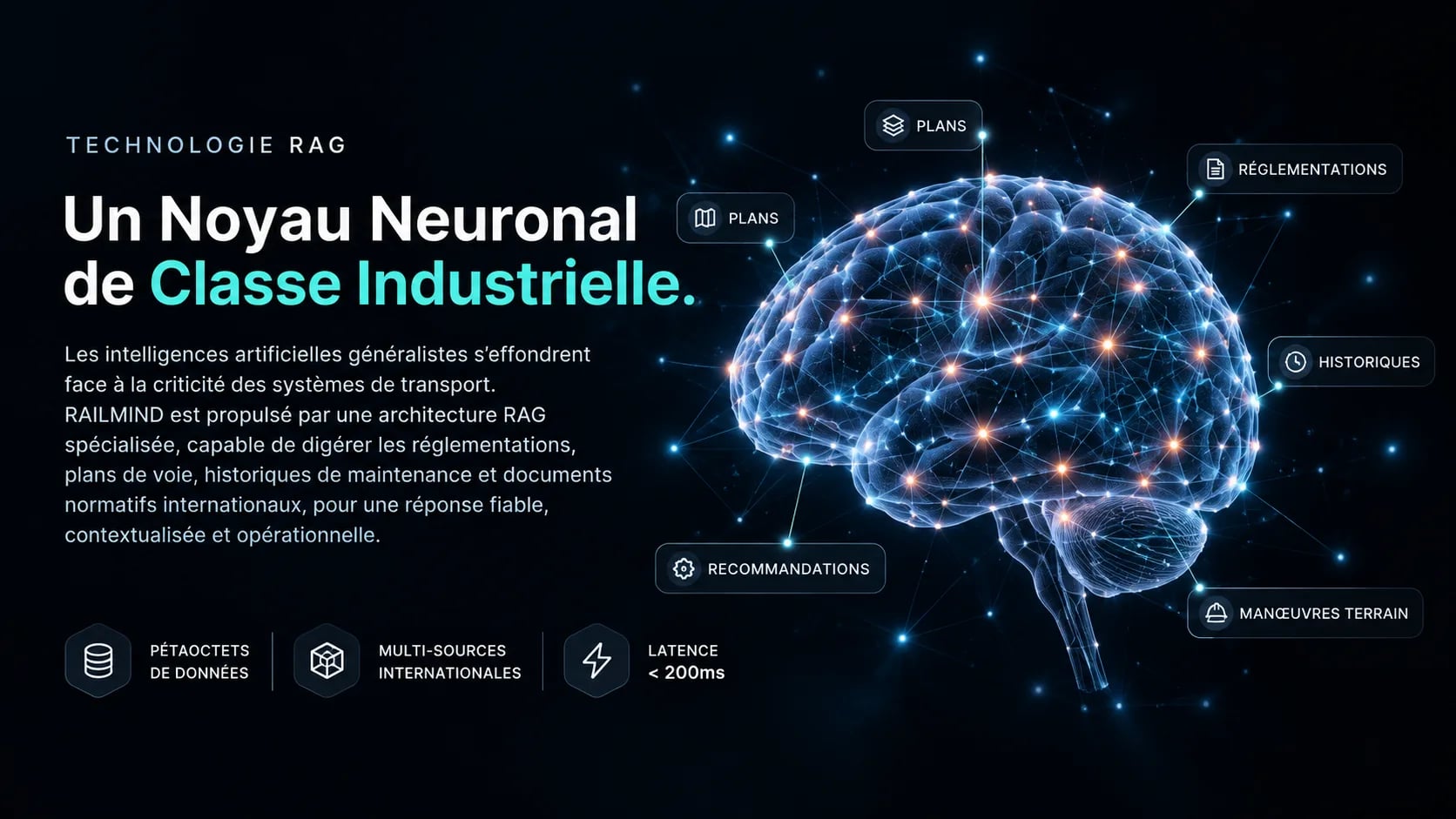
Ingestion of your documents in every format, hybrid search across your references and the EPSF, ERA, FRA, UIC and EN standards, sourced generation with every value verified. Sovereign cloud in Europe or On-Premise.
The engine that reasons over your references, page by page.
Multi-format ingestion, hybrid search across your documents and the EPSF, ERA, FRA, UIC and EN standards, sourced generation with every value verified: three phases, one rule, Source or Silence.
 01Stage 1
Vector Ingestion
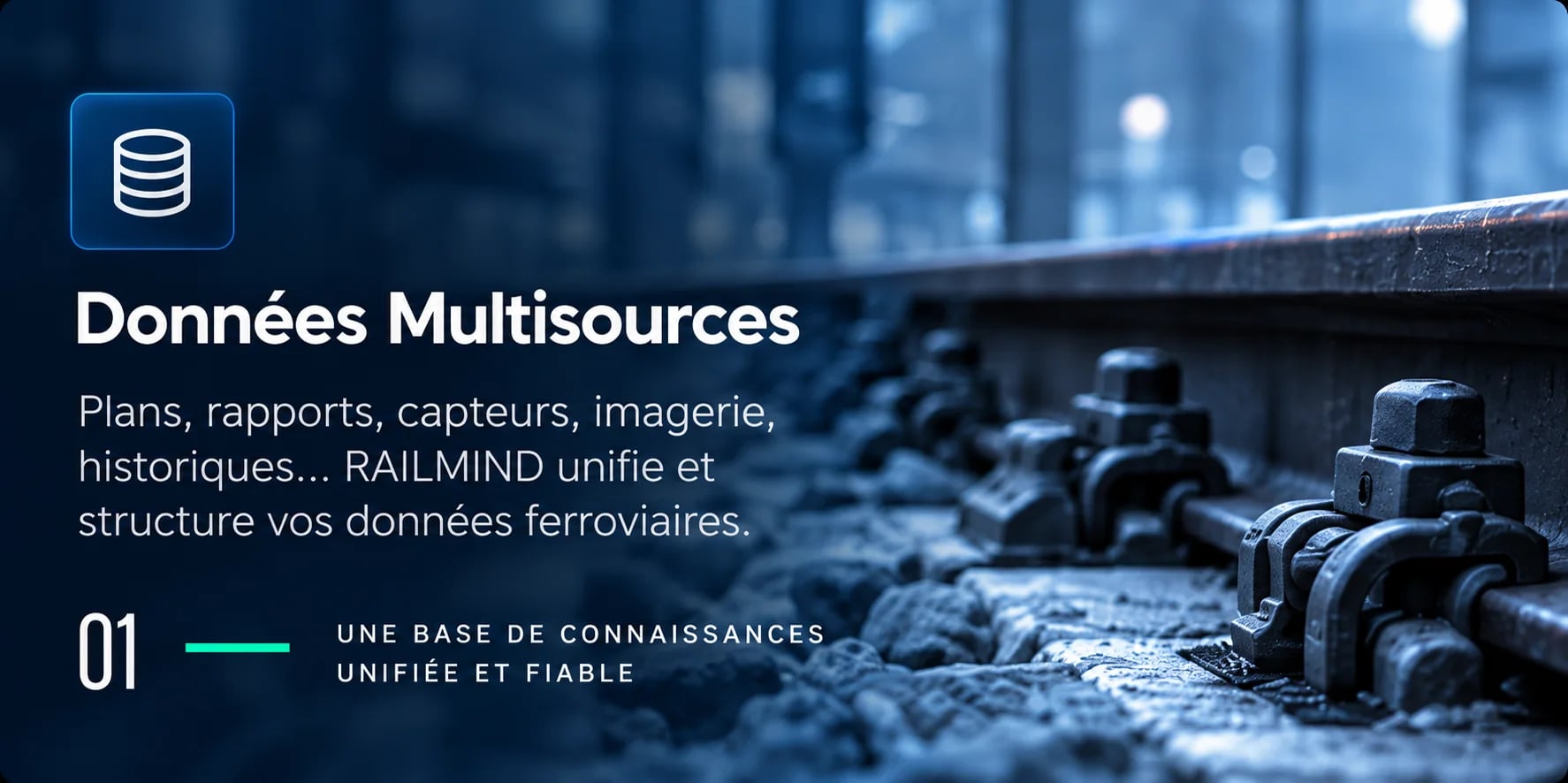
The platform connects natively to your ERP, CMMS, and document servers. It vectorizes your data: DWG switch plans, locomotive driving manuals, and historical failure libraries.
- Secure API connectors
- Industrial blueprint OCR
 02Stage 2
Active RAG Orchestration
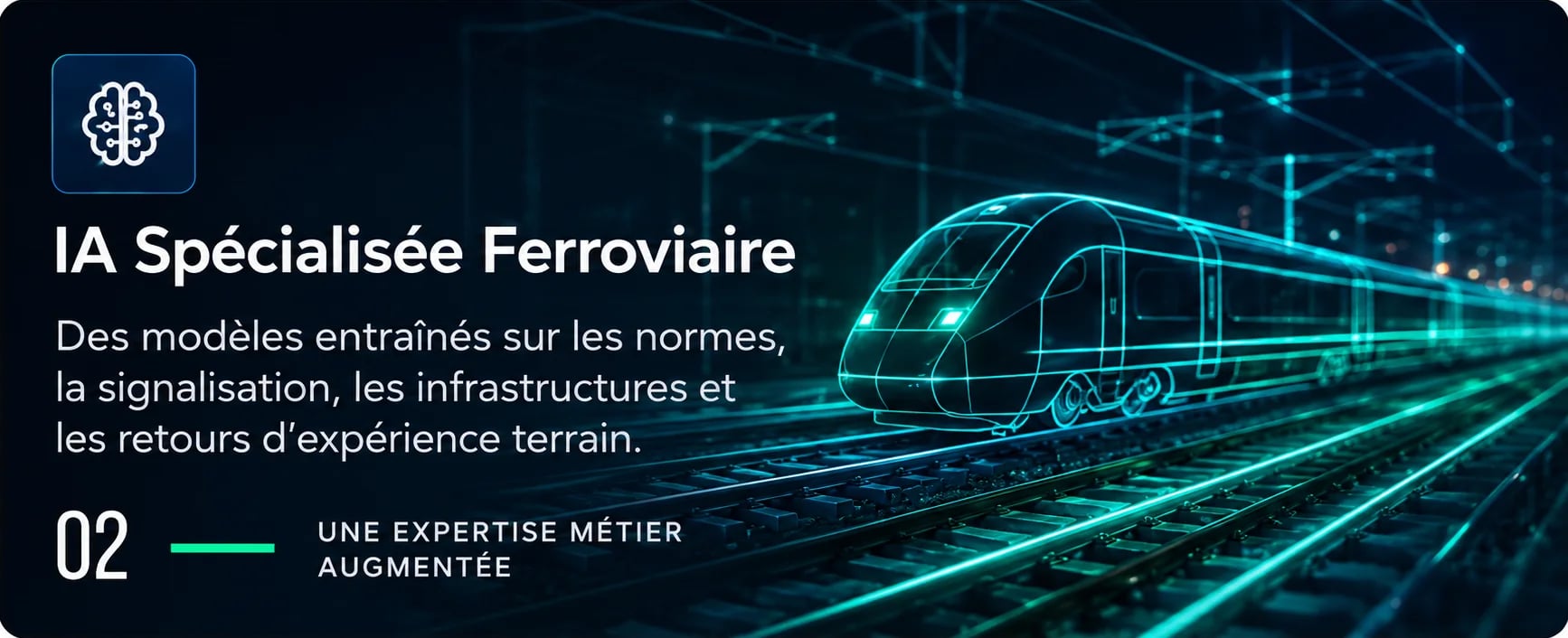
When an engineer asks a question, the engine dynamically queries your knowledge base. The AI cross-references active safety rules with field data for reliable, grounded reasoning.
- Anti-hallucination protocol
- Specialized railway reasoning
 03Stage 3
Output & Execution
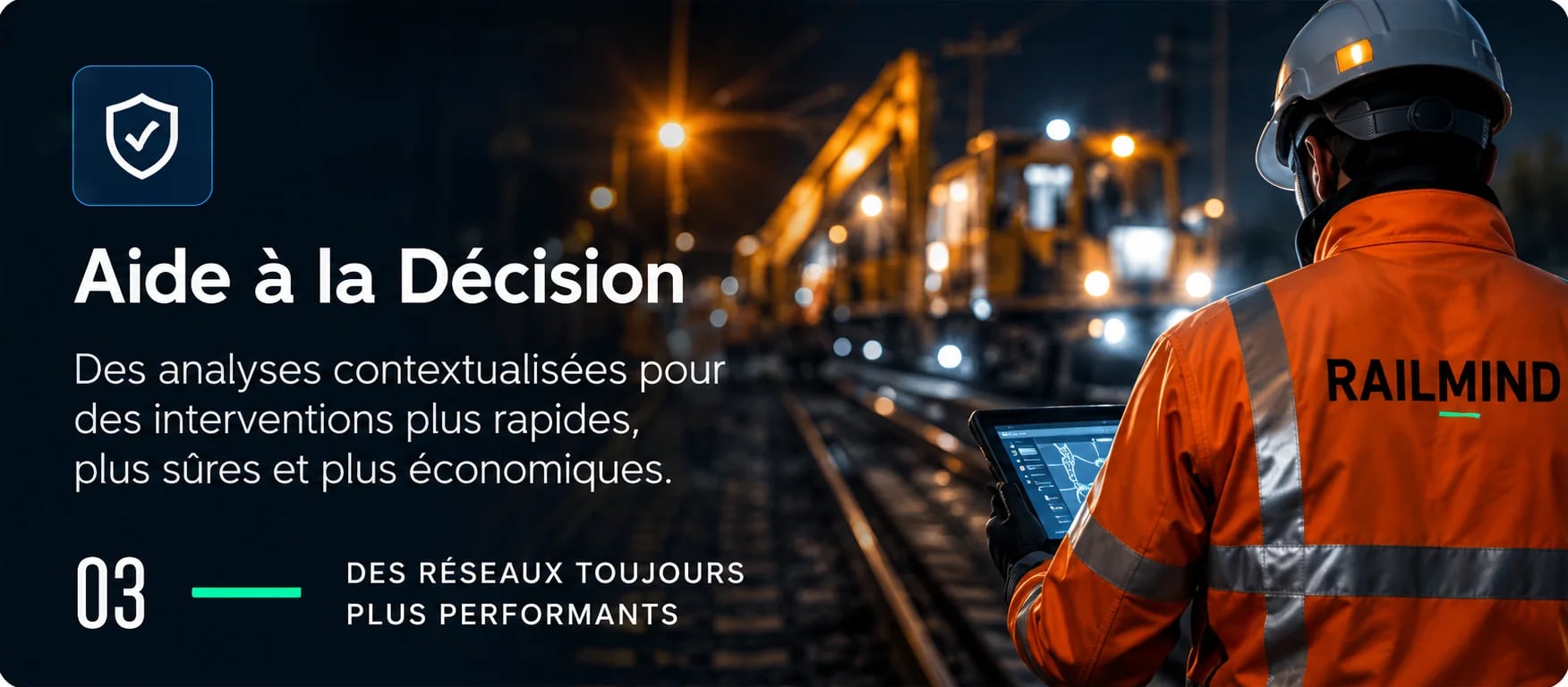
Answers are generated instantly with exact source citations. RAILMIND can also trigger automated workflows: pre-filling incident reports, generating safety forms, and triggering alerts.
- Exact source citations
- Automated workflows
Absolute “On-Premise” isolation
Heavy industry accepts no compromise on data sovereignty. RAILMIND Enterprise is designed to run on your own physical servers or on SecNumCloud-compatible sovereign clouds.

0.3 s per engine query
Hybrid search and embeddings in 0.3 seconds on Vertex AI in Europe; a complete, sourced and verified technical note in under a minute.
Railway-specialised engine
A domain glossary (ERTMS, KVB, speed restrictions, track possessions…) injected into every answer, acronyms expanded at search time, engineering logic enforced per question type.
Everything you give it, it learns.
Every file, photo, pasted dataset and validated answer joins your private corpus. The brain tells you what it lacks, and the regulatory watch feeds it every day.
PDF, native or scanned
Multimodal extraction, tables and page numbers preserved.
Photos
Nameplates, cab screens, defects, plans: exact transcription and technical observation.
DOCX, XLSX, CSV
Instructions, surveys, CMMS history, read natively.
Official links
EUR-Lex, eCFR, EPSF, manufacturer sheets: an address is enough.
The learning loop
- 01
You share
Import, attachment, WhatsApp photo, pasted data: indexed within seconds.
- 02
The brain asks
Every answer beyond the corpus names the missing references, ranked by frequency.
- 03
The watch feeds
Seven official sources checked daily, new or changed pages ingested.
- 04
You validate
A validated answer becomes company memory, weighted below the standards.
Per-customer isolation
Your corpus is never shared nor used to train a model.
Source or Silence
Every cited value is linked to its page and verified word for word.
Single database
Documents, conversations, usage and audit in one sovereign, exportable base.
Deliverables
Technical notes exported to DOCX or Markdown with sources and caveats.
Integrated standards & references
A global standard for smarter railways.

Built for the requirements of global operators:
- EPSFFrench framework
- ERAEuropean Union framework
- FRAUnited States framework
- SecNumCloudCompatible hosting
- ISO 27001In progress · GDPR
What we are asked most often
How does the document search engine work?
Search is hybrid. Lexical search finds exact terms, notably document codes and standard references, while vector search finds meaning even when wording differs. Both result lists are merged, then the retained passages are re-ranked before being handed to the model that writes the answer.
Which document formats are accepted?
PDF, images and photos, Word documents, spreadsheets, CSV files, HTML pages and web addresses. PDFs are processed with their layout in mind, which makes tolerance tables and drawings readable. Photos are analysed visually, so a defect can be sent as a picture rather than described.
Does the corpus grow on its own?
Yes, in three ways. Every uploaded document enters it automatically. Monitored official sources are re-read every night and changed pages are re-ingested. Finally, an answer validated by a user is kept as reusable memory, weighted below an official document.
Can RAILMIND be deployed on our own servers?
Yes. The platform ships as a container image with its embedded database, allowing deployment on your infrastructure. An internet-isolated mode is supported by pointing the language engine at a locally hosted model.
How do I verify an answer?
Every statement coming from the corpus carries its source: document name, reference, revision and page. The excerpts used are shown next to the answer, and the complete note exports to Word or Markdown to be filed in a record.
Does RAILMIND replace a railway expert?
No, and that is not the aim. It removes the document search time and presents information with its source, but the decision and its responsibility remain those of the qualified professional.

Modernize your engineering.
Enter the new era of railway maintenance and operations with Artificial Intelligence.